Center for Dharma Studies
MA, Sacred Texts and Interpretation
Concentration: Yoga Studies
Department of Religion and Practice
Interreligious Chaplaincy Program
Graduate Theological Union

Please create something that serves you and your own well-being. As time permits, students will be invited to share their portfolios with the class during our final class meeting.
PR-8315-1: RESILIANCE, WELL-BEING, AND CHAPLAINCY (Spring 2026)
Course Responses
RESILIANCE, WELL-BEING, AND CHAPLAINCY

Students will create a reflective and analytic map of religious and/or spiritual sources from your respective traditions and life experiences that help you to think about issues of resilience and well-being.
What does your tradition say about the importance of well-being? How is resilience demonstrated?
How do the identities, role expectations, sources of strain, supports, and risks to well-being affect you, your peers, and mentors within your faith or spiritual context?
Reflective Map
Painting a mandala allowed me to remember the feeling of putting "your all" into something, and that feeling of the universe.
The mandala became realized as the representation.
After painting the mandala, I feel that contemplation in relation to the three bodies in yoga philosophy has been reinforced.
To center in the center of the mandala, one could consider the three circles as the three bodies, with the outer fourth area that makes-up the limits (as the fourth space, the fourth, that is often noted toward in the Upanishads).
To contemplate on the energies of each body, noticing the subjective, cognitive, and objective worlds has provided for more clarity in relation to boundaries with others, to the point that I could finally allow myself to solely focus on my studies without others impending my study space.
Finding my study space led to further rooting with the Krama lineage, and now finally having a clear connection with perception.

Treya Sharira
Doctrine of Three Bodies in Yoga Philosophy


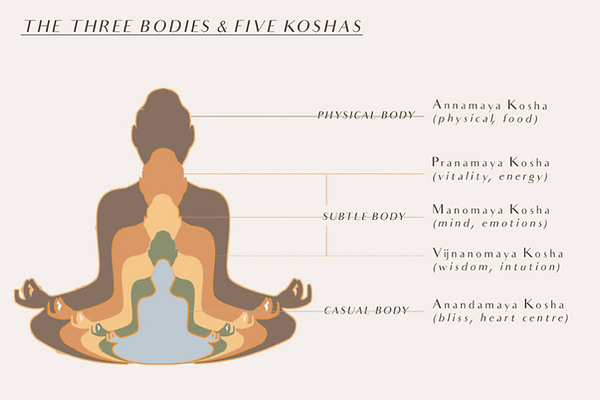
Contemplation
Objective world, Cognitive world, Subjective world
Initiative for Activism
Forest Chaplaincy
Students will analyze how a specific organization or system shapes caregiver well-being, attending to policies, culture, power dynamics, and moral climate.
I recommend using the Organizational System Map as a basic structure for considering not only how formal organizational or system policies may shape ideas about well-being and resilience among chaplains and other care providers, but also how informal or unspoken “rules” shape these expectations and norms within the organization.
Organization
A trauma response to 2020 led to grounding in the knowledge and action of forest chaplaincy, as I found practice in networking in a ministry of presence with an aim of offering a ministry of presence.
Forest chaplaincy is meant to hold space for a care of nature (and care for/with nature). My objective is to network in the name of chaplaincy, in that we connect with many different positions, locations, traditions, disciplines, cultures, arts.
--
1. Formal Organization. All explicitly agreed upon arrangements made between people about how to work together are part of the formal organization.
At this time, my focus is on organizing a ministry, to be a 501(c)3. This is consisting of a ministry service and production company, that is not-for-profit and offering free-of-charge services.
a. Structure. This details how work is split and assigned to specific people (differentiation) and to whom these people report (control).
The ministry is meant to hold space for a media group and a spiritual counsel, in which those committed to skills in production are differently encouraged to be a part of the group, while those that truly wish to offer sermons or ceremonies in the space are considered counsel.
b. Processes. These specify how people need to work together to complete multi-stage activities or exchange information (integration).
The media group is meant to hold space for cultivation of the production company side of the ministry, where a film crew is working together (encouraging each other's creative processes and finding projects to pursue together). In relation to the spiritual counsel, I suspect it may shift through time with more people stepping into different roles (while the aim is to hold space for a natural communion where different voices are heard in the community, representing different faiths and traditions).
c. Controls. These are the instruments used to steer people’s behavior, such as strategic planning and performance management.
The framework is to keep the process consensual, in which people may resonate in specific areas in relation to particular passions. The strategic planning in relation to ministry is left to initially the treasury and secretary, while more roles could arise in the ministry. The performance management in this ministry is truly more dedicated to the ways which we can connect with the community and find projects to do with community members, particularly in relation to theatre arts. There is no pressing issue to demand performance. Personally, I am a grant writer, while I hope this organization can also fundraise and appreciate donations. Receiving funds for this organization will all for us to build a film crew, improve forest chapel space, have open ceremonies for the community, invite different people to partake.
2. Informal Organization. When coordination between people develops organically, but isn’t formally arranged, we speak of the informal aspects of the organization.
In the case with chaplaincy, it is nice to remember that chaplaincy is tone for ministry and tune within ministry work. "Chaplaincy is a ministry that focuses on providing spiritual and emotional support to individuals in diverse environments outside traditional church settings. Chaplains serve as ministers in specialized contexts, offering a ministry of presence to those who may not have access to regular religious services due to health, confinement, or other circumstances" (Alan Baker, Faithward). Chaplains are able to be in very specific spaces and then connect with each other.
a. Networks. These are all connections established between people that can be used to exchange information, influence decisions, and/or get work done.
It is up for chaplains to decide what this means, in terms of how we connect with each other. The goal of forest chaplaincy is for chaplains to have awareness of natural burials and death rituals in practice, as well as building on the knowledge base for chaplains to connect with these practices. Furthermore, the sentiment of forestry it another area of consideration for chaplaincy, in which chaplains can connect and research on behalf of ecological conditions and environmental concerns.
b. Community. Even where people are not personally connected, they can experience a sense of belonging, team spirit and mutual responsibility vis-à-vis each other.
Forest chaplaincy is meant to remind us of all of the value of nature and nature preservation, as well as grounding to regulate the nervous system within nature life settings. With this at hand, one may come to find how nature facilitates a course of grief for each individual to sit with and within.
c. Leadership. While management is one of the controls, specified in the structure, leadership is the ability to influence others. This needs to grow, despite one’s position.
Forest chaplaincy can act as a container for chaplains to focus on nature in their area and consider arts in relation to ecosystems and where this may connect with a chaplain or another. Thus, informally we can encourage community and leadership, growth in leadership skills can be ongoing in the field together.
3. Organizational Members. The people that make up the organization are its members. There are three sub-aspects that need to be considered when looking at them.
While residing in a rainforest, my goal has been to find a way to hold space for a forest chapel. A joke was once made, that wherever I am, the forest chapel is, as in that I am facilitating space for grief and emotion as a presence. However, I am hoping to create space that can facilitate sacred sound as well as space to encourage self-study.
a. Individuals. The members can be viewed as a collection of individuals, each with their own personality, knowledge, skills, capabilities, and relationships.
At this time, I am focused on studying Myers-Briggs to consider the many personalities that I may encounter in ministry work. Furthermore, I want to hold space people to study Myers-Briggs and explore their own personality. Lastly, I am finding this is helping me decipher true danger in a person, whereby establishing boundaries. Myers-Briggs is becoming a way for me to sift through people to connect with and invite into the space, as well as getting to know the different abilities that people may bring to the ministry.
b. Population. The members also need to be viewed collectively to see how diverse and balanced the composition of each part of the organization is.
The aim of this organization is meant to hold space for many traditions, while I intend to check in with people to see where they are in relation to specific faiths. One could say that if there are an offset of traditions, then one could look into ways of expanding and outreaching. However, at this time, my goal is to connect primarily with Dhrama traditions, since that is my background and I find Dhrama is to be upheld spiritually, and social change could occur is these traditions are properly supported and acknowledged.
c. Engagement. The members also need to be viewed as more than a bundle of required resources (hands & heads), recognizing their energy and motivation (hearts & minds).
To recognize the heart as the intellect, then with the mind as the subconscious, and then with the gut as the will(power), there is an equilibrium to consider for each individual. For knowledge and action to come together and inspire change, we must all attend to this equilibrium. Disempowering others otherwise is the result of our actions. Thus, it seems essential for a ministry to assure there is a sense of empowerment (which the organization aims to instill, as well as encourage embodiment, whereby liberation). One way to assure there is ongoing empowerment is to not only facilitate space to feel willpower but to inquire whether individuals feel empowered. And to inquire into how there can be more improvement in the organization.
4. Organizational Culture. Lurking behind the three front disks is the organizational culture. The culture encompasses the shared worldview of the organizational members (their beliefs), the principles they hold dearly (their values) and the unwritten rules of behavior that follow from both (their norms). Culture subtly influences all three other organizational aspects and can only be influenced back via changes to these three.
The informal or unspoken “rules” in chaplaincy in terms of Dharma traditions are compassion, in which we suffer together, and without compassion in ministry there is misconduct.
We are to consider the influence of our own observations in a space, and we are to participate in spaces with self-reflexivity (in which we have a practice to encourage reflection and inquiry for the self to grow, and listen to concerns, and find peace within).
In feminist work, we can also attain connection to listening to and for abuse and misconduct. Considering issues of the misuse of power seems to be a hard area in the collective, as we do not want to face conflicting behaviors let alone abusive behaviors. Yet, we need to have a way to address and acknowledge abuse and misconduct. A ministry may be a safe space for this process of listening to unfold.
Meyer’s Management Models 34. Organizational System Map

Empowering
Chaplaincy, Networking and Finding Friendships

Participation in structured peer consultation sessions, followed by a reflective memo integrating course concepts.
Create a list of 3-4 questions you have about how fellow spiritual caregivers maintain well-being and resilience despite the many complex circumstances to which they are present.
Select a colleague within your current or past vocational setting (or a peer from our class if the former is not available to you) and spend 30-45 minutes speaking with that person, using the questions from your list as an interview guide to structure the conversation.
Peer Consultation
Although it seems my life has consisted of a variety of settings that have accumulated into being a chaplain as a vocation, I am considering the setting of counseling at a community setting to be my own initial knowing/feeling as a chaplain—in which I acted as a community chaplain. I had claimed to be a community chaplain because I realized I was offering spiritual counseling free-of-charge while lodging at a library in the mountain.
At this time, I was completing chaplaincy courses and was considered to be a scholar-in-residence. However, I ended up feeling like I was on-the-line 24/7 for the community, and I did not feel I had enough of a support system in/for this role. I now, more-or-less, consider myself a forest chaplain, as I reside in the forest and feel connected to the atmosphere around me, but I am not on-call with a local community. While initiating as a chaplain, as community chaplain, there was a core group of people around me with a variety of skills and cares for the community.
For this reflection, I inter-viewed with a friend that I made in this previous setting, after not seeing each other for a few months. This is one of my few friends, where I live in Chirripo mountain. It was an opportunity to realize that all those that I “do ethnography” with (within relation to theology) will be out of friendship. I have been slowed down with trauma in ethnography, within relation to anthropology and social change, particularly at People’s Park in 2020, and later in a modernist community that instilled abuse and misconduct in ritual and possession.
After years of contemplation and integration, I am finding that theology has now allowed me to hold boundaries within ethnography, while I do I wonder about ever being an investigated-like ethnographer into abusive settings—yet, I have come to find my interlocutors will not those who are continually in-stilling abuse.
Thus, theology holds this space of recognizing trust and those I am within ethnography with are friends. With this in mind, I was not sure who to essentially interview for this assignment. In the end, I found it was helpful to interview somebody close from the setting where I felt as a community chaplain.
In all, I found that by choosing to interview a friend, where there is already established trust, I had a breakthrough in my fieldwork. I now feel confident to interview more in the future, all thanks to the courage brought from this course.
My objective for a while was to live ethnography, though it became challenging to set-up formal interviews or even semi-structured interviews, while every moment is arguably an informal interview with the environment. In this semi-structured interview, I remembered the beauty that can unfold in an interview upon trust between two individuals.
In this interview, the three main questions were related to how one maintains well-being for the self in daily life, let alone when caring for others; the aim when could have when in counseling and caring; and what has one witnessed during the act of care.
The conversation allowed for a reconnection as well as brought an overall focus on the need to have supervisors and peers to talk to in relation to the experience of absorption from another in care.
With this at hand, the question about maintaining well-being as a self, led to a mention of trying to fit everything into your day, “eat a little, sweat a little, pray a little, and be helpful to others, if you want to feel good and make others feel good.” The sentiment of focusing on your own intrinsic needs, for the mind, body, and soul, sets the tone, while we were also brought to the notion that, “what I do to you, I do to myself.”
The question about the aim to sustain during offering care was — to not have expectations. This opens up space to hold and also does not cut you from your own freedom as a person of care.
The final question in relation to what has been witnessed as a person who cares, a father, a friend, led to a realizing statement, “We’re a body, that can, that can soul.” I was gratified by this statement, as I realized the beauty of the word counsel, that which “can soul.”
Lastly, the conversation ended with an area of resilience, realizing how the feeling of self-betrayal (energy of a moral injury) takes the most toll, creating the most weight as the main cause of exhaustion, so it is essential to take time to forgive yourself.
WELL-BEING OF CHAPLAINCY
A culminating integrative project articulating practices, commitments, and institutional strategies (where relevant) for your long-term resilience and well-being, and possibly that of other spiritual care providers.
This should be directly relevant to your own practice as a chaplain, so please consider
1) What do you need to support your long-term well-being and resilience as a spiritual care provider?
2) What is a concrete way to represent your needs to yourself (and others) (e.g. a written plan, a poem, prayer, or other creative writing project of your own?; a practice such as meditation; an original piece of artwork; a photo or collage; a course design, etc.)?
Culmination Integrative Project
{'I am' poem inspired in a Buddhist studies class on poetry and selfhood}
I am – a woman who wants to bear children. It feels unknown (a rite-of-passage) and necessary within my own value system.
I am – open for any other change or experience in my life.
I am – a person who always requires a cultivation of hope.
I am – one who appreciates hope.
I am – in tune with environments, while I wonder to what varying degrees—wondering if I can always go deeper in this in-tunement.
I am – sometimes under a lot of pressure—and there is a sense of overwhelm, looking for somewhere to turn—most of the time, I can find a way to sit in that.
I am – a swimmer loving water aerobics otherwise.
I am – one who is looking to recognize patterns of the nervous system in myself first before another.
I am – one who hopes not to project patterns on to you.
ABSTRACT With a goal toward a Master’s of Arts in Sacred Texts and Interpretation, my coursework in Hindu Yoga Studies have led me to emphasize the necessity of intersubjective hermeneutics rather than mere interpretation. I was encouraged to take note of the GTU 360 Sustainability Initiative, developing an aim for an eco-praxis. While initiating into yoga studies through the Center for Dharma Studies, applying acoustemology with a Śākta perspective seems essential for understanding sacred sound, the spirit of rasa, and absolution into music. While studying at the Graduate Theological Union, my research focus became how intuition is unveiled within a contemporary worlding, vis-à-vis a Dharma transmission. Within the Department of Religion and Practice, I suggest I naturally came to focus on this subject matter, while scholastically studying Sanskrit sacred texts, and implementing a vocational religious practice while living in Latin America.