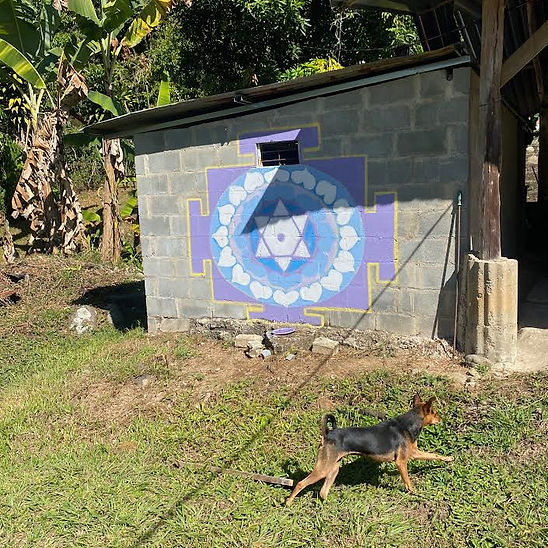
Yantra
Yantra, or sacred geometry, in an ancient art which changes the vibrations around us. Combining yantra with mantra leads to elevation of consciousness.
The Kali Yantra is sacred as a geometrical shape that holds an honorable space for each of these 24 elemental goddess energies. Thus, these petals and points of the Kali yantra hold the energy of the 24 goddess-related elements of Prakriti, the cosmic female principle.
Silently call forth on the regenerative power of Kali, which has the power to transform the deepest suffering into the deepest bliss and wareness. Close your eyes now, but let the image of the yantra remain with you. Chant the sacred breath of Ma Kali, "sa'ham," and stay relaxed and peaceful.

Ma Kali

Sacred Forests
Sustainability Act - Forest Chaplaincy

Nature reminds the sage of the truth sensed in the teachings. My research focuses on multiple aims toward critical indigenous epistemologies for eco-theological reflection on vision quests and rite-of-passages as sages, while I know that I personally hold a Śākta perspective as an ontology of the Veda.
Acoustemology and modes of recording with another has granted a focus on ethnography, while an anthropology of the body lends scholars the ability to borrow time to self-reflect. Acoustemology is an indigenous epistemology and Steven Feld stated it is not intended to declare truth, while it is meant to hold space for the reflection and recording of another. With a Śākta perspective, I consider yoga as an intersectionality of interfaith, with the yoking process felt as dialogue, where we can experience the areas of communication between parts within the whole -- while ontologically, I sense the whole as the Great Goddess.
Initially, my research aimed to explore the benefit of ministry in (sacred) forests, to expand upon ecological awareness and unconditional love that is revealed in prevalent in the ethics within Sanātana Dharma, where archeology and religious studies signify Hinduism, where the Veda becomes the Vedas. While recognizing Hindu ecological “cosmovisions” encountered with many traditions, I explore sustainability ethics within Caitanya Vaisnava and eco-theological motifs that are passages for integration and absorption into peace and harmony.
Now I aim to direct my studies to anchor a ministry within the network of forestry. While accounting for the puruṣārthas (aims of a human life), I intend to acknowledge significant Vedic ecological visions as well as and explore eco-theological motifs. Where one may consider the Veda as an eco-praxis, is where one notices the interviewing of humanity within the Vedas. With this at hand, one may also realize the ongoing nature of ākāśa that one is weaving, and where one experiences an awareness of destiny and predestination.
Furthermore, I aim to amplify the purpose of exploring religious sources for sentiment on interacting with the forest, while drawing attention to how Hinduism imbues divine love and awareness. I find that following the practice of self-renunciation as an experience in forest life leads to natural techniques of satyagraha (persistence in search of truth).
Not that we are without truth, while knowing the necessity of its quest. Just as the forest brings awareness of the whole, knowing chaplaincy allows us to mend and amend. The area of considering death and dying, chaplaincy brings awareness to the whole. Remembering faith an intrinsic value of an individual being, thus may faith be.
Chandra yantra has become the mandala for my sacred path.